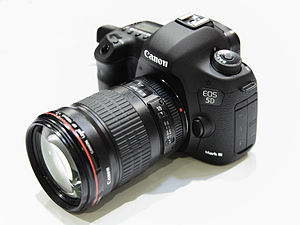
Canon EOS 7D
 The Canon EOS 7D is an 18.0 effective megapixel APS-C crop CMOS digital single-lens reflex camera made by Canon.It was announced on 1 September 2009 with a suggested retail price of US$1,699. Its particularly notable features are HD video recording, its 8.0 frames per second continuous shooting, new viewfinder which offers 1.0X magnification and 100% coverage 19 point auto-focus system, movie mode, and built-in Speedlite transmitter.
Features
- 18.0 effective megapixel APS-C CMOS sensor
- Dual DIGIC 4 image processors with 14-bit processing
- Liveview mode
- 100% viewfinder frame coverage with 1.0× magnification
- 1080p HD video recording at 24p, 25p and 30p with drop frame timing
- 720p HD video recording at 50p (50 Hz) and 60p (59.94 Hz)
- 480p ED video recording at 50p (50 Hz) and 60p (59.94 Hz)
- 8.0 frames per second continuous shooting
- ISO sensitivity 100–6400 (expandable to 12,800)
- 3.0-inch Clear View II LCD screen with 640 × 480 (921,600 dots) resolution
- 19 point auto-focus system, all cross-type
- 63 zone color sensitive metering system
- built-in Speedlite transmitter
- Magnesium alloy body
- Popup flash
- Weather Sealing
[edit]Autofocus and metering
The 7D has 19 autofocus points arranged in a horizontal diamond pattern. The AF system is a new design which uses a translucent LCD display in the viewfinder. The camera uses TTL 63 zone color sensitive metering system with four variations (evaluative, center-weighted, partial, spot) and exposure compensation of −3 EV to +3 EV in steps of 1/3 EV.E-TTL II flash metering is provided. The translucent LCD can also display guide lines and the spot metering area circle. As with most other video-capable DSLRs, the Canon EOS 7D’s autofocusing function does not work while recording video. Instead, you can only trigger a contrast-detect AF cycle before recording process by hitting the AF button on the camera's rear panel. You can manually focus the lens during a recording.
[edit]Shutter
The shutter is rated to 150,000 shots, and is capable of speeds up to 1/8000 sec, with a flash sync speed of 1/250 sec.
[edit]Ergonomics
The 7D has roughly the same dimension as the 5D Mark II, with the button layout having gone through an update. It also features a 100% viewfinder with 1x magnification.
The 7D was the first Canon camera with a dedicated movie mode switch, the preceding 5D Mark II and 500D movie recording being done in live view.
[edit]Speed
The dual Digic IV processors let the 7D reach 8 frames per second continuous shooting; the buffer throughput allows up to 94 frames in large JPEG mode, and up to 15 frames in RAW. A future firmware update announced by Canon in June 2012 may increase the buffer size to 26 RAW frames.
[edit]Firmware update
In August 2012 new firmware v2.0 will be released with the following enhancements:
- Improved maximum burst for RAW images (up to 25)
- In-camera RAW image editing
- In-camera Image Rating
- In-camera JPEG resizing
- Maximum Auto ISO setting (ISO 400-6400)
- Manual audio level adjustment in movie recording
- GPS compatibility
- File name customisation
- Time zone settings
- Faster scrolling of magnified images
- Quick control screen during playback
[edit]Awards
The Canon EOS 7D won the 2010–2011 European Advanced SLR Camera and the Technical Image Press Association Best DSLR Expert awards.
[edit]Video
The Canon EOS 7D's video functions offers an unusually strong feature set that gives the photographer/videographer more control over the videos they create. The camera also offers the ability to record audio from an external source. Both shutter and aperture are available for manual control, and the 7D also provides multiple frame rate options, including three that match the HD television timing specs. Like most DSLR modes, the Canon 7D neglects endless autofocus during video recording, which is a great concern for advanced amateurs with pros likely to focus manually nonetheless. Separate movie clips that are captured by the Canon EOS 7D are limited to twelve minutes in the high definition 1080p and 720p modes, or 24 minutes in the standard definition VGA mode.
The Canon 7D has acquired significance in the independent filmmaking world as an affordable alternative to digital cinema cameras. The camera was used on feature films, such asBlack Swan, Stanley Ka Dabba. and Vazhakku Enn 18/9